Yo! Welcome back to The Reeder Newsletter. Because it's a holiday weekend in the States, you're getting a replay of one of my most popular emails from 2024. Enjoy!
Your favorite AI might be lying to you about your brand visibility.
Three months ago, I asked ChatGPT to rank the top 10 B2B marketing podcasts. Mine made the list. I celebrated until I realized the truth: it was giving me personalized answers (aka what I wanted to hear). When strangers searched? They saw nothing about me. So I started using Ahref's Brand Radar. It shows your visibility across every major AI platform in seconds, so you know what your audience really sees when they search. Now you can fix your "invisible brand" problem and start winning AI visibility.
I’ve signed three advisor contracts in my career. Two were amazing. I met brilliant people, tackled new challenges, and helped GTM leaders grow their businesses. It made me a better marketer and operator. But one ended abruptly — with the founder throwing a tantrum and deciding never to speak to me again. Egos are a weird thing. (Especially in SaaS.) We all make “bad calls,” and looking back, I should never have taken that role. But I didn’t have any coaching. I did the classic “figure it out as you go” approach. Cue the bumps and bruises.
A couple of months ago, my friend and mentee, Nehal Tenany, called me with a question:
Should I join this company as an advisor?
For context, Nehal has been in SaaS marketing for 7 years. She was on my founding content team at Gong and was my #2 at Clari. When the opportunity came up, she was excited. Then she asked: “What does an advisor actually do?” Luckily, Nehal didn’t have to figure it out alone. And neither do you.
Here’s what most folks ask — or wish they had sooner (like me)
What is an advisor, exactly?
What’s expected of me?
How do I evaluate if this company is worth my time?
How does compensation work?
Will my employer care?
These are the questions I wish I had answered before jumping into my first advisor role. If you’re wondering what it’s like to be an advisor, here’s where to start. But first…
Do you even want to be an advisor? Here are the Pros and Cons.
You’ve probably seen “Advisor” or “Strategic Advisor” titles on LinkedIn.
(Side note: Isn’t the “strategic” part implied? God, I hope so.)
I always wondered what that whole advisor thing really meant.
It sounds fancy, important, and... cool?
But what’s it really about? Here’s the breakdown:
Pros
Valuable Experience: You get to solve new challenges outside your day-to-day role. You’ll encounter different problems that build your ability to think strategically across industries.
Builds Depth: It adds layers to your professional expertise. Each new challenge as an advisor strengthens your skill set and credibility.
Compensation: It’s often not life-changing, but think of it as “car money,” not “house money.” While it won't pay the mortgage, it can supplement your income in the future.
Networking: You get access to new circles of professionals. Advising opens doors to future opportunities that can benefit your career in the long term.
Cons
Extra Workload: It’s more on your plate, beyond your 9-to-5. Balancing a full-time job and advisory work can be exhausting for some people.
Limited Time: You won’t be fully immersed in the company, so your impact may be limited. Advisors aren’t in the trenches daily, which can limit hands-on influence.
Unreliable Compensation: It’s not always a solid income stream. Equity and cash can fluctuate, and most companies don't have successful exits.
TL,DR: l I think it's worth it.
BUT, if you’re in it just for the money, don’t bother. Do it for the learning, the experience, and the impact you can have.
(1) What does an advisor do, exactly?
The short answer is, it depends.
Most SaaS start-ups are short on talent and experience, so founders usually hire people with solid track records to guide them.
Important: An advisor is not a consultant.
Consultants are hands-on and often “do the work.”
Advisors are coaches who give advice.
For me, it's been around specialized areas like marketing strategy, content strategy, social media, and audience growth.
(2) What’s expected of me?
This will vary based on the company’s needs.
Here’s what’s typical from my advisor contracts:
Attend monthly or quarterly strategy sessions
Give feedback on product-market fit
Help design go-to-market strategies
Review key messaging and positioning
Introduce potential customers or partners
*Limited* social media shout-outs
Warning: If you’re only being asked to post on LinkedIn every month, you’re not really an advisor. You’re an influencer. I joked about this with Morgan J. Ingram and Mark Huber on his podcast, The Proof Point.Jump to 30:28 for a good laugh.
(3) How do I pick the right company?
I could’ve avoided heartburn and burned bridges had I known this sooner. Before you sign on any digital dotted line, consider this:
Do you believe in the product and vision?
Does the leadership team seem coachable?
Can you confidently contribute to their growth?
Is there a clear go-to-market strategy in place?
Does the company’s mission align with your values?
Engagements are usually two-year commitments, so take your time and be intentional.
(4) How does compensation work? AKA how will I get paid?
Most contracts trade your time for options.
It'll look something like this:
(Again, pulling from offers I’ve received and accepted)
A small equity percentage (0.25-1%)
Monthly or quarterly cash payments
Vesting periods over 1-2 years
Optional travel expense coverage for key meetings
Remember, if you’re getting paid in options, they must have a successful exit for you to get paid.
Otherwise, you’re basically working for free.
(5) Will your employer care?
Most likely, no. SaaS execs are often advisors themselves. But here’s what I’d do:
Check your employee contract for any clauses about outside work.
If your employer has strict rules, proactively bring it up.
Otherwise, you don’t need to mention it, but be upfront if asked. Just make sure there’s zero competitive overlap between your employer and the company you’re advising. This is the exact advice I gave Nehal, and...
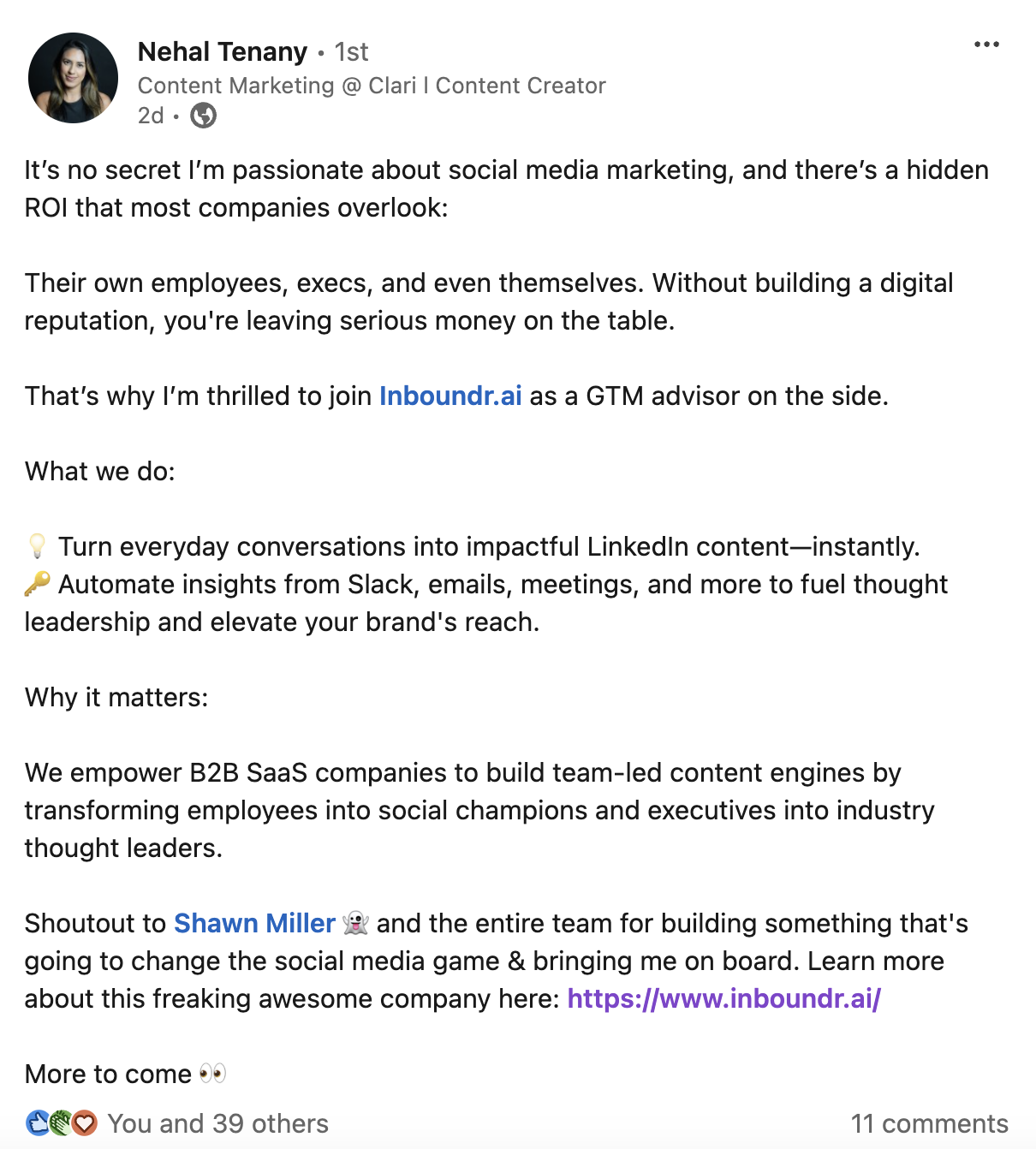
She ended up taking that role and announced it this week(!)
This makes me happy :)
She met with their founder, researched the space, and talked to me (and others) instead of rushing into signing. Brava! 👏🏻
Recap
Advising can be a game-changer for your career. You get hands-on experience, build connections, and yeah, potentially make some extra cash. But it’s not all sunshine and roses—you’ve gotta put in the work, and deliver, and the financial gain might not work out. If you're considering stepping into an advisor role, ask the tough questions, vet the company, and be crystal clear on how it aligns with your goals.